Source Sustainable Wood Glass Storage Jar for Home, Kitchen, and Decor
Find 30 sustainable wood glass storage jar options with acacia lids and high borosilicate glass bodies. Compare capacities, certifications, and customization features for home, kitchen, and decorative uses.
Key considerations
Products List






Comprehensive Sourcing Guide
Strategic Sourcing Guide for Sustainable Wood Glass Storage Jars
The global demand for eco-conscious packaging and home organization has elevated the profile of sustainable wood glass storage jars. These products combine the chemical inertness and clarity of glass with the renewable, biodegradable properties of wood, offering a dual benefit of functionality and aesthetic appeal. For B2B procurement professionals, sourcing these items requires a nuanced understanding of material integrity, supply chain transparency, and specific technical attributes. This guide provides a disciplined framework for evaluating suppliers and products, ensuring that procurement decisions align with both sustainability goals and operational requirements.
Technical Specifications and Material Composition
The foundation of a high-quality storage jar lies in the precise definition of its material composition. In the current market, the glass component is predominantly manufactured from high borosilicate glass. This material is distinct from standard soda-lime glass due to its superior thermal shock resistance and durability. Procurement teams must verify that the raw material specification explicitly states "High Borosilicate Glass" to ensure the product can withstand temperature fluctuations without cracking, a critical feature for food storage applications. The glass itself is typically produced through a blowing process, which creates a seamless, round, or cylindrical shape. Dimensions vary significantly by model, with observed specifications including heights up to 47cm and diameters around 21.5cm, though smaller spice jar sets are also common.
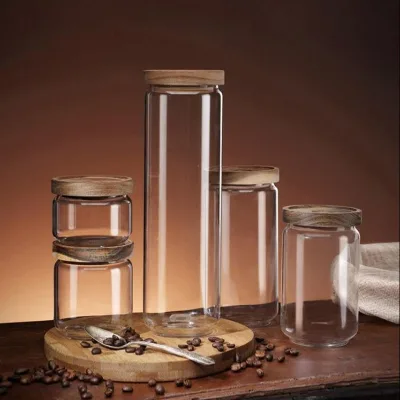
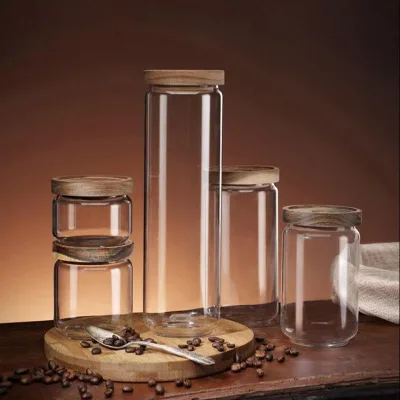
The wooden element of the jar is equally critical to the product's sustainability profile. The most frequently observed lid material in this category is Acacia wood. Acacia is a hardwood known for its density, resistance to moisture, and natural grain patterns, making it ideal for food-contact surfaces. However, the sustainability of the wood is not solely determined by the species; it is also defined by the processing method. Some suppliers utilize Acacia wood combined with food-grade silicone seals to ensure an airtight closure, which is essential for preserving the freshness of stored goods. The wood is often left in its natural state or treated with specific glazes as shown in product imagery, but buyers must confirm that any finishes are non-toxic. The weight of these units is a significant logistical factor; a standard 450ml unit may weigh approximately 150g, but this varies based on glass thickness and wood density.
Compliance, Certification, and Safety Standards
When sourcing glass and wood storage solutions, compliance with food safety standards is non-negotiable. The primary certifications observed in this sector include FDA approval and ISO standards. These certifications indicate that the materials used, including the glass and the wood, have been tested for safety and do not leach harmful substances into food products. Buyers should explicitly request documentation proving that the "High Borosilicate Glass" and "Acacia Wood" components meet these specific regulatory requirements. The standard "glass + wood" combination must be validated as safe for direct food contact.
Beyond material safety, the manufacturing process must adhere to strict hygiene protocols. The processing methods, such as blowing and polishing, should be conducted in facilities that maintain clean-room standards to prevent contamination. While some background information suggests the possibility of FSC (Forest Stewardship Council) certification for the wood, this should not be assumed. Procurement teams must verify the origin of the wood and request specific chain-of-custody documentation if FSC certification is a mandatory requirement for the buyer's corporate sustainability goals. The absence of such certification does not necessarily imply unsustainability, but it requires a deeper inquiry into the forestry practices of the supplier.
Cost Drivers and Pricing Dynamics
The pricing of sustainable wood glass storage jars is influenced by a complex interplay of material costs, labor intensity, and order volume. The observed price range in the market spans from $0.10 to $10.35 USD, a wide variance that reflects differences in size, complexity, and customization levels. Several key factors drive these costs. First, the use of high borosilicate glass is inherently more expensive than standard glass due to the raw material and energy-intensive manufacturing process. Second, the inclusion of Acacia wood lids adds cost, particularly if the wood is sourced from sustainable forests or requires additional finishing processes like polishing or debossing.
Customization is another major cost driver. Products offering customized logos, specific sizes, or unique shapes (such as the "C3-1/2/3/4" or "GA171-35A" models) often command higher prices. The Minimum Order Quantity (MOQ) also plays a pivotal role in unit pricing. The observed MOQ range is between 40 and 10,000 units. Smaller orders, closer to the 40-unit threshold, will typically carry a higher per-unit cost due to the fixed costs of setup and tooling. Conversely, larger orders can leverage economies of scale to reduce the unit price. Packaging requirements, such as "Safe Packaging" or custom cartons, also add to the final cost. Buyers should be aware that "Fashion" or "Japanese Style" designs may involve more intricate molding or finishing, further influencing the price point.
Typical Applications and Market Segmentation
The versatility of wood glass storage jars allows them to serve multiple market segments, from industrial food packaging to consumer home goods. The primary application is for daily use in food storage, where the airtight seal provided by the wood and silicone combination preserves spices, grains, and dry goods. The "Food" usage category is dominant, with specific models designed as spice jar sets containing 1 to 3 pieces. These are often marketed with a "Simple" or "Original" style, appealing to consumers who value minimalism and functionality.
Beyond food storage, these jars are increasingly used for decorative purposes in home and hospitality settings. The "Decorative" application leverages the aesthetic appeal of the wood grain against the transparency of the glass. The "Modern" and "Japanese Style" attributes make them suitable for retail environments, boutique hotels, and high-end residential decor. Some models are specifically designed as "Glass Storage Jars with Acacia Cover," targeting the home organization market. The ability to accept OEM/ODM orders allows suppliers to tailor these products for specific brand identities, whether for a private label spice brand or a home decor retailer. The "Folded: Unfolded" attribute suggests some designs may have collapsible or modular components, adding to their utility in compact living spaces.
Supplier Evaluation and Verification Protocols
Selecting the right supplier requires a rigorous evaluation process that goes beyond price comparisons. Given that the origin of these products is predominantly China, with specific mentions of Hebei as a production hub, buyers should assess the supplier's logistical capabilities and export experience. A reliable supplier must demonstrate transparency regarding their production location and capacity. The ability to provide "Customized Logo" options and "Debossed" designs indicates a mature manufacturing process capable of handling branding requirements.
Buyers should verify the supplier's quality control systems. Since the product involves both glass and wood, the risk of breakage during transit and the risk of wood warping or cracking are significant. Suppliers should offer "Safe Packaging" solutions that are specifically designed to protect the fragile glass and the delicate wood lids. The "prod_packing" attribute often lists "Carton" or "Customized" options, and buyers must ensure that the packaging materials are sufficient to prevent damage during long-distance shipping. Additionally, the "OEM/ODM: Acceptable" status should be confirmed with a clear understanding of the lead times and the minimum requirements for custom orders.
Quality Control and Long-Term Procurement Considerations
Ensuring consistent quality in wood glass storage jars requires a robust quality control (QC) protocol. Inspection points should focus on the integrity of the glass seal, the smoothness of the wood finish, and the accuracy of the dimensions. The "Shape: Round" and "Size: Dia.21.5X47cm H" specifications must be met within tight tolerances to ensure the lids fit securely. Any gaps between the wood and glass can compromise the airtight seal, leading to food spoilage. Furthermore, the "Glaze Type" must be consistent with the product description and free from lead or cadmium, especially if the wood is treated.
For long-term procurement, buyers should consider the scalability of the supply chain. The "prod_model" variations, such as "Y-032" or "KC22005," suggest a range of SKUs that a supplier can manage. A supplier capable of handling a wide range of models is better positioned to support a buyer's growing product line. Sustainability is also a long-term consideration; buyers should inquire about the supplier's commitment to responsible sourcing of Acacia wood and their waste management practices during the glass blowing and polishing processes. The "Feature: Safe Food Grade Ware" claim must be backed by ongoing testing and certification renewals.
Comparative Analysis of Product Attributes
To facilitate decision-making, the following table summarizes key attributes observed in the market for sustainable wood glass storage jars. This comparison helps buyers distinguish between standard and premium offerings based on material, certification, and customization.
| Attribute Category | Standard Offering | Premium / Custom Offering | Verification Requirement |
|---|---|---|---|
| Glass Material | Standard Glass | High Borosilicate Glass | Request material test reports |
| Lid Material | Basic Wood | Acacia Wood + Food Grade Silicone | Verify silicone food-grade certification |
| Certification | General ISO | FDA + ISO | Request valid certificate copies |
| Customization | Standard Logo | Debossed Logo + Custom Shape | Confirm MOQ for custom molds |
| Packaging | Standard Carton | Safe Packaging + Custom Box | Review packaging drop-test results |
| Origin | General China | Hebei, China Specific | Verify factory address and audit |
| Style | Simple / Original | Japanese Style / Fashion | Review product imagery for accuracy |
Conclusion
Sourcing sustainable wood glass storage jars is a strategic endeavor that balances aesthetic appeal with functional performance and regulatory compliance. The market offers a diverse range of products, from simple spice jars to elaborate decorative sets, all unified by the use of high borosilicate glass and Acacia wood. Buyers must navigate a landscape defined by varying MOQs, price points, and customization options. By rigorously verifying material specifications, demanding proof of FDA and ISO certifications, and evaluating supplier capabilities for safe packaging and OEM services, procurement professionals can secure a supply chain that supports both business objectives and sustainability commitments. The key to success lies in detailed due diligence, ensuring that every unit delivered meets the high standards required for food safety and environmental responsibility.
FAQs
What certifications do sustainable wood glass storage jars have?
These jars typically hold FDA and ISO certifications to ensure safety. The glass is made from high borosilicate material while the lids use acacia wood. Buyers should verify these specific documents before placing orders.
Can I get customized logos on these glass storage jars?
Yes, customized logos are available for these products. Suppliers accept debossed designs and can apply branding to the glass or wood surfaces. This service often requires meeting a minimum order quantity to be viable.
Which material is used for the lids of these jars?
The lids are primarily made from acacia wood, sometimes combined with food-grade silicone seals. This combination ensures an airtight closure suitable for storing spices and dry goods. The wood provides a natural, sustainable aesthetic.
How much does a 450ml glass storage jar weigh?
A standard 450ml unit weighs approximately 150 grams. This weight depends on the thickness of the high borosilicate glass and the density of the acacia wood lid. Packaging must account for this weight during shipping.
What is the typical minimum order quantity for these jars?
The minimum order quantity ranges from 40 to 10,000 units depending on the supplier. Smaller orders near 40 units may carry higher per-unit costs due to setup fees. Larger volumes leverage economies of scale.
Where are these sustainable wood glass jars manufactured?
These products originate from China, with specific production hubs noted in Hebei. Buyers should verify the factory address to ensure supply chain transparency. The origin impacts logistics costs and lead times significantly.
What packaging options are available for these glass jars?
Packaging options include standard cartons and customized safe packaging solutions. Suppliers use these methods to protect the fragile glass and delicate wood lids during transit. Custom boxes can be arranged for specific branding needs.